
Pain-free gardening

Spring has sprung and many of us head out into the garden. Gardening is a great form of exercise but unfortunately, it is a common cause of back pain. To enjoy pain-free gardening, consider the tips below from West Lakes Physio.

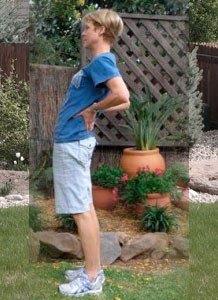
    1. Stretching backward after you have been bending forward and stretching out your legs after squatting and kneeling, should help keep you moving during your gardening session. Stretch slowly until you feel a gentle pull and hold each stretch for 10 – 15 seconds. Repeat 2 times.
    2. Work between waist and shoulder height as much as you can to protect your back. Use a table to re-pot plants whenever possible. When working at ground level for weeding and planting out, kneel on the ground rather than bend from your waist.
    3. A “kneeler” is very useful if you have trouble getting back up or if you have sore knees.

4. Vary your activities so you are not in one position for more than 30 minutes.

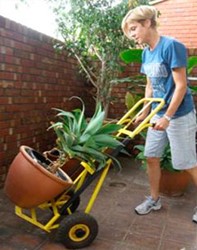
5. If you move a pot regularly, put it on wheels.  A sack trolley is useful to move pots a long way. Rolling the pot instead of dragging it, is better for your back. Use a wheelbarrow to transport heavy objects. Don’t overfill and keep the weight over the wheel.

6. Planting your pot plants in garden beds means no need for re-potting and less hand watering.

7. Lifting Heavy Items

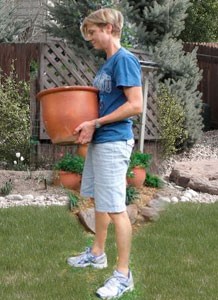
Remember the rules for lifting. Make sure the area you need to carry things over is clear of obstacles. Get some help if the object is heavy. You need to coordinate the lifting effort so that you both lift the object together (i.e. Count out loud “1…2…3…lift”).

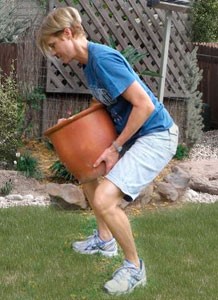
Start with feet shoulder distance apart. Bend at the knees and hips with your bottom stuck out. Grip the object firmly and keep the load close to your body.

Brace your stomach muscles to protect your spine and keep your back as straight as possible throughout the lift.

Walk slowly and avoid twisting when lowering the object.
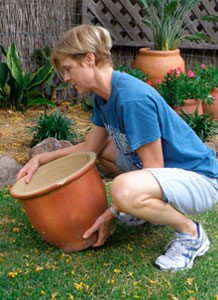


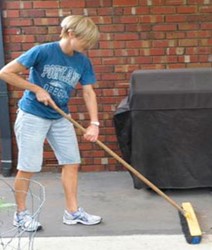
8. When sweeping, push the broom and work  in front of you. A smaller broom may be easier to manage if you have back problems, or use a light blower vac.
9. Using a garden hose for hand watering is much kinder on the back than buckets and water cans.

10.When using buckets for fertilising, try using two buckets half filled with water and carry one in each hand to balance your load.

If it hurts—STOP. Listen to your body. Pain is often felt before major damage is caused when you are digging and bending forward. This is a warning that you need to change position. If the pain doesn’t subside with this, then it is time to stop for the day. If pain persists, consult your doctor or physiotherapist.

We hope these tips are useful so you can enjoy pain-free gardening this spring.

Book Your Physiotherapy Appointment Today

📍 Conveniently located in West Lakes
📞 Call 8347 2043

West Lakes Physio - Sports & Rehab

EXPERIENCE THE WEST LAKES PHYSIO DIFFERENCE TODAY

BOOK NOW
Comments Box SVG iconsUsed for the like, share, comment, and reaction icons
🦶 When should you

🦶 When should you see a physio for ankle pain?

Ankle pain isn't always something you need to simply put up with. Whether you've rolled your ankle playing sport, noticed ongoing stiffness, or developed pain that just won't settle, a physiotherapy assessment can help identify what's going on and get you moving confidently again.

Here are 5 signs it might be time to see a physio:

🔹 You've rolled your ankle
Even a seemingly minor ankle sprain can affect your balance, strength and joint stability. Repeated ankle sprains may indicate that your ankle hasn't fully recovered.

🔹 You have ongoing pain or stiffness
If your ankle continues to feel stiff, sore or restricted, particularly first thing in the morning or after activity, it's worth having it assessed.

🔹 You experience a pinching pain
A sharp pinching sensation at the front or sides of your ankle, particularly when squatting, lunging or moving into certain positions, may indicate an underlying joint or soft tissue issue.

🔹 You've noticed a sudden pop or click
A sudden pop accompanied by pain, swelling or difficulty weight-bearing can sometimes indicate a more significant injury. Even without a major injury, persistent painful clicking deserves attention.

🔹 Your ankle just doesn't feel right
If you're avoiding certain activities, feeling unstable or lacking confidence when running, jumping or walking, don't ignore it.

How can physiotherapy help?

At West Lakes Physio, our experienced physiotherapists will assess your ankle, identify contributing factors and develop an individual treatment and rehabilitation plan to help restore strength, mobility and confidence.

Don't let ankle pain hold you back!

📍 Book an appointment with our team at West Lakes Physio.

#WestLakesPhysio #AnklePain #AnkleSprain #SportsPhysio #Physiotherapy #InjuryRehabilitation
...

⛳🧠 AI fun time!

⛳🧠 AI fun time! Mark and Shane love sneaking off for quick round. Did you guess right? 😄

Happy Friday from WEST LAKES PHYSIO-SPORTS & REHAB! Whether you’re teeing off this weekend, or just keeping up with your usual plans, we’re here to help you feel strong, move better, and recover smarter. 💪✨

#WestLakesPhysio #PhysioRehab #HappyFriday
...

⛳Quick quiz for ou

⛳Quick quiz for our WEST LAKES community! How well do you know your physio? Who loves golf?

Their swing might still need some work, but when it comes to getting you back on track, they’re right on target. 😅

Comment your guess below! 🤔🏌️

#GolfTherapy #PhysioSports #TeamWestLakes
...

🦶 How long does a

🦶 How long does an ankle sprain take to heal?

It's one of the first questions people ask.

The answer depends on the severity of the injury, the amount of tissue damage and how well the ankle is rehabilitated.

Ankle sprains occur when the ligaments supporting the ankle are stretched or torn. They are graded according to the severity of soft tissue damage.

🔹 Grade 1 – Mild sprain
The ligament has been overstretched
Mild pain and swelling.
Usually able to walk with minimal difficulty.
Approximate recovery: 1–3 weeks.

🔹 Grade 2 – Moderate sprain
There is a partial tear of the ligament.
More noticeable pain, swelling and bruising.
Walking may be uncomfortable or difficult.
Approximate recovery: 3–6 weeks.

🔹 Grade 3 – Severe sprain
There is a complete tear of the ligament.
Significant swelling and bruising.
Often considerable difficulty weight-bearing.
Approximate recovery: 8–12+ weeks.

🧬 What happens during soft tissue healing?

Ligaments don't heal overnight! Soft tissue healing occurs in several overlapping phases:

1️⃣ Inflammatory phase (first few days): The body responds to the injury, with swelling and inflammation helping initiate the repair process.

2️⃣ Repair phase (days to weeks): New collagen fibres are produced to repair the damaged tissue.

3️⃣ Remodelling phase (weeks to months): The collagen fibres gradually reorganise and strengthen in response to appropriate loading and rehabilitation.

This is why ankle recovery is about more than simply waiting for the pain and swelling to settle.

At West Lakes Physio, we can assess your ankle injury, guide your recovery and help you safely return to the activities you enjoy.

Remember: Just because the pain has settled doesn't necessarily mean your ankle has fully recovered!

📍 West Lakes Physio – helping you get back on your feet.

#WestLakesPhysio #AnkleSprain #AnkleInjury #SportsPhysio #Physiotherapy #InjuryRecovery
...

Join Our Newsletter

"*" indicates required fields

Name*
MENU